
Knee Pain Causes Related Muscles and Massage Modalities for Relief
Knee pain rarely comes from the knee joint alone. The knee sits between the hip, thigh, lower leg, and foot, so irritation in nearby muscles, tendons, nerves, or joints can change how it moves and where pain is felt. A painful kneecap may reflect quadriceps overload. Inner knee pain may involve the adductors or pes anserine tendons. Pain behind the knee may come from the hamstrings, calf, popliteus, or a Baker cyst.
This article is for general education and does not replace medical evaluation. Sudden swelling, inability to bear weight, fever, severe trauma, calf swelling, numbness, or pain that worsens despite rest should be assessed by a licensed health professional.
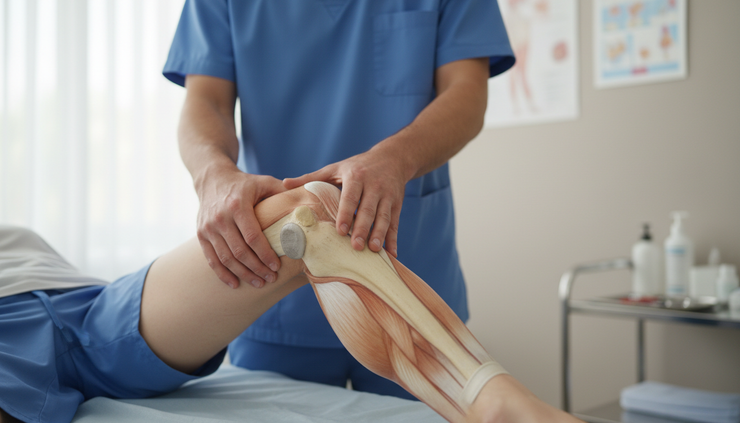
Common causes of knee pain
Knee pain can develop from a single injury, repetitive strain, joint degeneration, inflammation, or referred pain from another region. The location of pain gives useful clues, but it is not a diagnosis by itself.
Acute injury
A twist, fall, direct blow, or sudden stop can strain or tear knee structures. Common acute injuries include:
Ligament sprains
The anterior cruciate ligament, posterior cruciate ligament, medial collateral ligament, and lateral collateral ligament help stabilize the knee. Injury may cause sharp pain, swelling, bruising, or a feeling that the knee gives way.
Meniscus injury
The menisci are cartilage pads that help distribute load. A tear may cause joint line pain, swelling, catching, locking, or pain with squatting and twisting.
Muscle or tendon strain
The quadriceps, hamstrings, calf, or popliteus can strain during running, jumping, lifting, or sudden direction changes.
Overuse and load-related pain
Repetitive stress may irritate tendons, bursae, or the kneecap joint. This type of pain often builds gradually.
Patellofemoral pain usually presents around or behind the kneecap. It may worsen with stairs, squats, running, prolonged sitting, or kneeling. Contributing factors can include quadriceps weakness, hip weakness, limited ankle mobility, increased training volume, or altered foot mechanics.
Patellar tendinopathy often causes pain just below the kneecap, especially with jumping, running, and deep knee bending. Quadriceps overload commonly plays a role.
Quadriceps tendinopathy tends to cause pain above the kneecap, where the quadriceps tendon attaches.
Iliotibial band pain usually appears on the outer knee, especially in runners or cyclists. The pain may relate to hip control, training changes, and sensitivity where the iliotibial band interfaces with the lateral knee.
Arthritis and joint degeneration
Osteoarthritis can cause aching, stiffness, crepitus, swelling, and reduced range of motion. Pain may be worse after activity or after long periods of sitting. Morning stiffness can occur, but it is usually shorter than the stiffness seen with inflammatory arthritis.
Rheumatoid arthritis and other inflammatory joint conditions can also affect the knee. These conditions may cause warmth, swelling, prolonged morning stiffness, and pain in multiple joints.
Bursitis and tendon irritation
Bursae are small fluid-filled sacs that reduce friction. Bursitis can occur after kneeling, direct pressure, trauma, or repetitive movement.
Common sites include:
Prepatellar bursa in front of the kneecap
Pes anserine bursa on the inner knee below the joint line
Infrapatellar bursa below the kneecap
Pes anserine pain is often confused with medial knee joint pain. It involves the area where the sartorius, gracilis, and semitendinosus tendons attach.
Referred pain from the hip, back, or nerves
Pain felt at the knee may originate elsewhere. Hip osteoarthritis can refer pain to the front or inner knee. Lumbar spine irritation can refer pain into the thigh, knee, or lower leg through nerve pathways. Femoral nerve irritation may create symptoms in the front of the thigh and knee, while sciatic-related symptoms may travel down the back or outer leg.
Referred pain is more likely when knee testing does not reproduce the main symptoms, or when pain includes tingling, numbness, burning, weakness, or symptoms that change with back or hip position.
Muscles that commonly relate to knee pain
Muscles influence knee alignment, joint load, and soft tissue tension. A tight or overactive muscle can irritate local tissues. A weak or poorly coordinated muscle can increase strain elsewhere.
Muscle or muscle group | Common pain pattern | Clinical relevance |
Quadriceps | Front of knee, above or below kneecap | Controls knee extension, kneecap tracking, stairs, squats |
Hamstrings | Back of knee, inner or outer knee | Controls knee flexion and supports posterior knee stability |
Gastrocnemius | Back of knee and calf | Crosses the knee and ankle, irritated by running, hills, and prolonged standing |
Popliteus | Deep back or outer-back knee | Helps unlock the knee and controls rotation |
Adductors | Inner thigh and inner knee | Can refer pain toward pes anserine area |
Tensor fasciae latae and iliotibial band | Outer thigh and outer knee | Often involved in lateral knee pain |
Gluteus medius and maximus | Hip, outer thigh, sometimes knee | Controls hip position and knee alignment |
Sartorius, gracilis, and semitendinosus | Inner knee below joint line | Attach at the pes anserine region |
Quadriceps and kneecap-related pain
The quadriceps group includes the rectus femoris, vastus lateralis, vastus medialis, and vastus intermedius. These muscles straighten the knee and guide kneecap movement.
Trigger points or increased tone in the quadriceps may refer pain to the front of the knee. Rectus femoris can also contribute to hip flexor tightness, which may increase anterior knee stress during squatting or running. Vastus lateralis tension may be associated with lateral tracking forces at the patella, while poor vastus medialis control may reduce medial support.
Massage may help reduce protective muscle guarding in the quadriceps, but lasting improvement often requires graded strengthening and movement retraining.
Hamstrings and posterior knee pain
The hamstrings attach near the back and inner or outer sides of the knee. The semitendinosus and semimembranosus attach medially, while the biceps femoris attaches laterally near the fibular head.
Hamstring-related pain may feel like tightness or aching behind the knee. It can worsen with running, deadlifting, sprinting, or prolonged sitting. Biceps femoris irritation may mimic lateral knee pain, while medial hamstring irritation may overlap with pes anserine symptoms.
Calf and popliteus contributions
The gastrocnemius crosses the back of the knee before continuing into the Achilles tendon. Tightness or trigger points may create posterior knee discomfort, especially when the knee straightens and the ankle dorsiflexes.
The popliteus is a small but clinically relevant muscle behind the knee. It helps control tibial rotation and assists with unlocking the knee from full extension. Irritation may cause deep posterior knee pain, especially during downhill walking, running, or twisting.
Calf pain with swelling, warmth, redness, or shortness of breath needs urgent medical evaluation because vascular conditions, including deep vein thrombosis, must be ruled out.
Hip muscles and outer knee pain
The gluteus medius and gluteus maximus help control the position of the thigh during walking, running, stairs, and squatting. When hip control is limited, the knee may drift inward or rotate excessively, increasing stress at the kneecap or outer knee.
The tensor fasciae latae connects into the iliotibial band. Excess tone in this region may contribute to outer thigh and lateral knee sensitivity. Direct aggressive pressure on the iliotibial band is often poorly tolerated and may not address the primary driver. Treatment commonly focuses on the tensor fasciae latae, gluteal muscles, lateral quadriceps, and movement control.
How radiated or referred pain may feel
Radiated pain usually follows irritation along a nerve pathway. Referred pain is felt away from the source but may not follow a clear nerve line. Both can affect the knee.
Common patterns include:
Hip joint pain felt in the groin, front thigh, or inner knee
Lumbar spine pain traveling into the thigh, knee, shin, or foot
Femoral nerve symptoms affecting the front thigh and knee
Sciatic-related symptoms affecting the back of the thigh, outer leg, or foot
Trigger point referral from quadriceps, adductors, hamstrings, or calf muscles
Signs that pain may involve nerve irritation include:
Burning, tingling, or electric sensations
Numbness or altered skin sensation
Weakness in the thigh, ankle, or foot
Pain that changes with spinal posture
Symptoms below the knee that are not explained by local knee findings
Massage may reduce muscle guarding around nerve-sensitive areas, but it should not be used as the only treatment when neurological symptoms are progressing.
Massage modalities that may help relieve knee pain
Massage does not repair a torn ligament, reverse advanced arthritis, or replace rehabilitation. It may help reduce pain sensitivity, improve local circulation, decrease muscle tone, and support comfortable movement. The best results often occur when massage is combined with exercise, load management, and appropriate medical care.
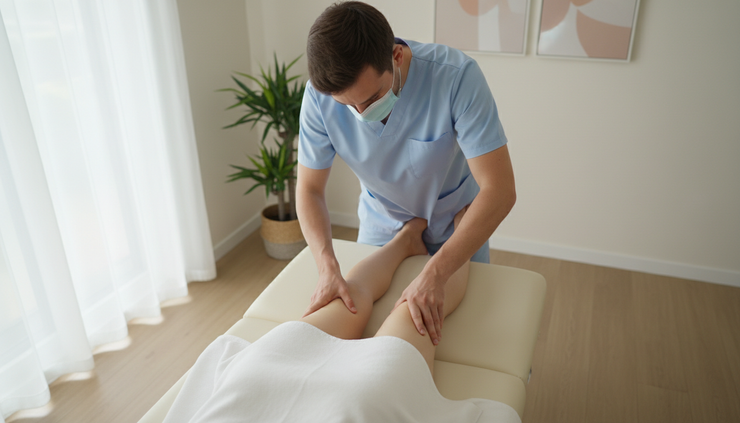
Swedish massage for pain modulation and relaxation
Swedish massage uses gliding strokes, kneading, and gentle rhythmic pressure. It is often appropriate when pain is irritable, the person is guarded, or the goal is general pain relief.
For knee pain, Swedish techniques may be applied to the quadriceps, hamstrings, calves, gluteals, and lower back. Treatment does not need to focus only on the painful point. Gentle work around connected regions can reduce protective tension and make movement feel safer.
This approach is often useful for osteoarthritis-related stiffness, mild overuse pain, and muscle guarding after activity.
Myofascial release for soft tissue restriction
Myofascial release uses sustained pressure and slow tissue engagement. The goal is to reduce sensitivity and improve glide between layers of muscle and fascia.
Clinically relevant areas may include:
Lateral quadriceps and tensor fasciae latae for outer knee pain
Quadriceps and hip flexors for kneecap-related pain
Hamstrings and calf for posterior knee discomfort
Adductors for inner knee tension
Pressure should remain tolerable. More force does not mean better results. Excessive pressure can increase soreness and protective guarding.
Trigger point therapy for referred muscle pain
Trigger points are sensitive areas within muscle that may reproduce local or referred pain. In knee-related cases, trigger point work may target the quadriceps, adductors, hamstrings, gastrocnemius, soleus, popliteus region, tensor fasciae latae, and gluteals.
A useful clinical sign is familiar pain reproduction. For example, pressure into the vastus medialis may reproduce inner-front knee symptoms, or gastrocnemius pressure may recreate back-of-knee discomfort.
Trigger point therapy should use controlled pressure, short holds, and reassessment. Lingering bruising or sharp pain is not the goal.
Neuromuscular therapy for movement-related pain
Neuromuscular therapy combines assessment, precise manual pressure, and attention to muscle function. It may be helpful when knee pain is associated with altered gait, muscle imbalance, or compensatory tension.
A clinician may assess hip rotation, ankle mobility, pelvic control, and the way the knee tracks during squats or step-downs. Manual work can then focus on tissues that appear to contribute to the movement pattern.
This style is especially relevant when symptoms keep returning after temporary relief.
Sports massage for training-related knee symptoms
Sports massage often blends Swedish massage, deeper tissue work, stretching, compression, and active movement. It can be useful for runners, cyclists, lifters, and recreational athletes who develop knee pain from training volume or repetitive loading.
Treatment may focus on recovery after hard sessions, reducing muscle tone before a return to activity, or maintaining mobility during a graded training plan. It should not be used to push through acute injury signs such as swelling, instability, or sharp joint pain.
Manual lymphatic drainage for swelling management
Manual lymphatic drainage uses very light, specific strokes to encourage fluid movement. It may help when mild swelling or post-activity puffiness is present, especially after medical clearance.
Deep massage directly over a swollen, hot, or acutely injured knee is not appropriate. Swelling after trauma, unexplained swelling, or swelling with calf pain should be evaluated first.
Cross-fiber friction for selected tendon problems
Cross-fiber friction uses small, targeted strokes across a tendon or ligament region. Some clinicians use it for chronic tendon irritation, such as patellar or quadriceps tendinopathy.
This method should be applied selectively. It is not appropriate for acute tears, highly inflamed tissue, or unexplained pain. It may create short-term soreness, so dosage matters.
When massage should be avoided or modified
Massage is not always safe for knee pain. Avoid or seek medical guidance first if any of the following are present:
Recent major injury with severe swelling or deformity
Inability to bear weight
Suspected fracture, ligament rupture, or tendon rupture
Fever, redness, heat, or signs of infection
Calf swelling, calf tenderness, or unexplained shortness of breath
New numbness, progressive weakness, or loss of bladder or bowel control
Active inflammatory flare with marked warmth and swelling
Recent surgery unless cleared by the surgical team
Massage should also be modified for people taking blood thinners, those with fragile skin, advanced diabetes-related sensation changes, or vascular disease.

A practical clinical approach to massage for knee pain
A good session starts with assessment, not pressure. The practitioner should ask about onset, location, swelling, locking, instability, training changes, medical history, and aggravating movements.
A typical plan may include:
Screen for red flags
Rule out signs that need medical referral.
Assess related regions
Observe knee range of motion, hip mobility, ankle mobility, gait, squat pattern, and muscle tenderness.
Treat the most relevant tissues
Focus may include quadriceps, adductors, hamstrings, calf, gluteals, tensor fasciae latae, and lower back.
Reassess movement
Pain, range of motion, stair tolerance, or squat comfort should be checked after treatment.
Add home care
Gentle mobility, graded strengthening, pacing, and appropriate recovery habits help results last.
For many cases, massage provides a window of reduced pain. That window is most useful when paired with controlled movement. Examples include short-arc knee extensions, glute bridges, step-ups, calf raises, or hip abduction work, chosen based on tolerance and diagnosis.
The takeaway on knee pain and massage
Knee Pain Causes Related Muscles and Massage Modalities for Relief is a broad topic because knee symptoms can come from joint structures, tendons, bursae, muscles, nerves, the hip, or the spine. Pain location helps guide assessment, but it does not provide a full diagnosis.
Massage may help when muscle guarding, soft tissue sensitivity, overuse, or movement-related tension contributes to symptoms. Swedish massage, myofascial release, trigger point therapy, neuromuscular therapy, sports massage, manual lymphatic work, and selected friction techniques can all have a role when used appropriately.
The safest path is to match the modality to the clinical picture. Persistent, swollen, unstable, traumatic, or nerve-related knee pain deserves medical evaluation. For non-urgent cases, skilled massage combined with progressive exercise and load management can support pain relief, better movement, and more confident daily activity.
At Hybrid Therapeutic Massage, we provide free consultation for the massage related based on your health conditions, budget, and time to maximize pain alleviation.
! Call for free consultation: 857-262-9468
! Booking: Hybrid Therapy (Chronic pain), Deep tissue, Swedish or Myofascial Release on www.hybridtherapeuticmassage.com/book-online
! Visit our website to learn more at: www.hybridtherapeuticmassage.com


Comments