
How To Do Clinical Massage on the Neck to Alleviating Pain?
Updated: May 22
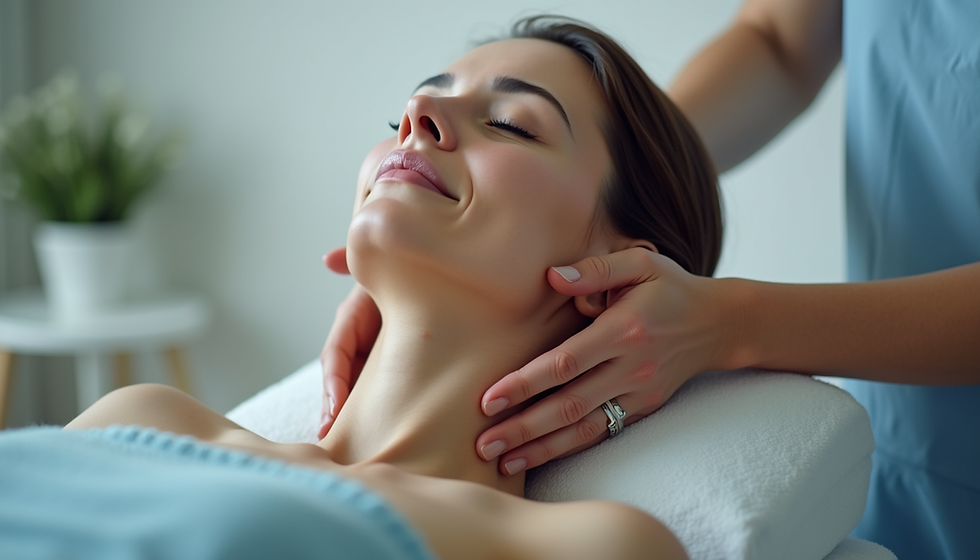
A “clinical” neck massage is less about strong pressure and more about assessment, precision, and safe targeting of specific structures. The goal is to reduce guarding, restore mobility, and calm irritated soft tissue—without overstimulating sensitive areas of the cervical spine.
Here’s a professional, step-by-step way to approach it:
1. Start with Assessment (Always first)
Before touching deeper tissue, observe and ask:
Where is the pain located (one side, base of skull, shoulder referral)?
What movements are limited (rotation, side bending, flexion)?
Any red flags? (dizziness, numbness, radiating arm pain, headache changes)
Visually check posture:
Forward head posture (common)
Elevated shoulder on one side
Protective guarding (stiff, minimal movement)
This tells you which muscles are likely involved.
2. Create Safety and Relaxation
Position: supine with head supported (neutral spine)
Use bolsters if needed under knees
Warm the area first (hands or hot towel)
Work slowly to reduce nervous system guarding
Clinical rule: If the nervous system is guarding, deep pressure will be resisted.
3. Begin with Superficial Layer Release
Start broad, not specific:
Effleurage along neck and upper traps
Gentle sweeping from occiput → shoulders
Light compression to reduce tone
This prepares:
Upper trapezius
Sternocleidomastoid (SCM)
Superficial fascia
4. Target Key Muscles (Most commonly involved)
Sternocleidomastoid (SCM)
**{SCM: flexion + rotation of cervical spine}
Work with light to moderate pressure only
Pinch-and-roll or gentle stripping along muscle belly
Avoid carotid sinus area (anterior neck safety zone)
Upper Trapezius
**{Upper Trapezius: elevation + neck extension support}
Use slow compression and stripping from neck → shoulder
Combine with active breathing to reduce guarding
Great response to sustained pressure holds (10–20 sec)
Levator Scapulae
**{Levator Scapulae: scapula elevation + neck rotation/side bend restriction}
Access by guiding head into slight opposite rotation
Work from upper medial scapula toward cervical attachment
Often responsible for “stuck turning” sensation
Sub-occipitals (deep posterior neck)
**{Sub-occipitals: fine motor control of head posture and extension}
Very gentle sustained pressure at base of skull
Small sustained holds (not sliding friction)
Often linked with tension headaches and limited rotation
5. Add Gentle Joint-Friendly Movement (Very important clinically)
After soft tissue softening:
Passive neck rotation (small range)
Side bending with support
Assisted movement with client feedback
Rule: Never force range—invite it.
6. Finish with Nervous System Downregulation
Light effleurage
Slow breathing guidance
Light traction (if trained and appropriate)
Encourage relaxation response
This helps prevent rebound tightness.
Key Clinical Principles
Neck = high-risk area → precision over force
Always work superficial → deep → movement integration
Pain reduction comes from reducing protective muscle guarding, not just “breaking knots”
SCM, upper trap, levator scapulae, and sub-occipitals are the primary patterns in most restricted rotation cases


Comments